


Key Points
Summary
Elon Musk and US President Donald Trump found themselves in a highly publicized feud, marked by Musk's call for Trump's impeachment and insinuations about withheld Jeffrey Epstein files, while Trump threatened to terminate Musk's government contracts. The conflict, fueled by disagreements over GOP tax legislation that would cut electric vehicle credits affecting Tesla, led to a 14% drop in Tesla shares and a $34 billion loss in Musk's wealth. Musk initially criticized Trump harshly but later signaled a willingness to cool tensions, agreeing to maintain SpaceX's Dragon spacecraft operations and responding positively to calls for peace from allies like Bill Ackman. The dispute has placed Republican lawmakers in a difficult position, forced to navigate loyalties between Musk, a significant financial backer, and Trump, a dominant political figure. Efforts to mediate include a scheduled White House call with Musk and statements from figures like House Speaker Mike Johnson urging that policy differences remain impersonal. The clash highlights deeper tensions over policy and personal influence, with potential legal and practical challenges if contracts with Musk’s companies, integral to US space and defense, are severed.
Key Points
Summary
US stock futures showed little movement on Thursday as investors focused on upcoming labor data and developments in President Trump's tariff policies. Dow Jones, S&P 500, and Nasdaq 100 futures hovered near flat after a recent rally lost momentum, fueled by concerns over weak private-sector hiring and services data. Unemployment claims hit an eight-month high for the week ending May 31, with continuing claims near a four-year peak, indicating a cooling labor market. The awaited May jobs report on Friday is expected to shed light on economic impacts from trade changes. Meanwhile, China's rare-earth export curbs have escalated trade tensions, affecting the US auto industry, with production halts at Ford and others. On the corporate side, Lululemon and Broadcom are set to release earnings, while Tesla's stock fell over 3% in premarket trading as Elon Musk publicly criticized Trump's tax bill. Silver prices also surged to a 13-year high, reflecting broader market dynamics and investor interest in safe-haven assets amid geopolitical and trade uncertainties.

Key Points
Summary
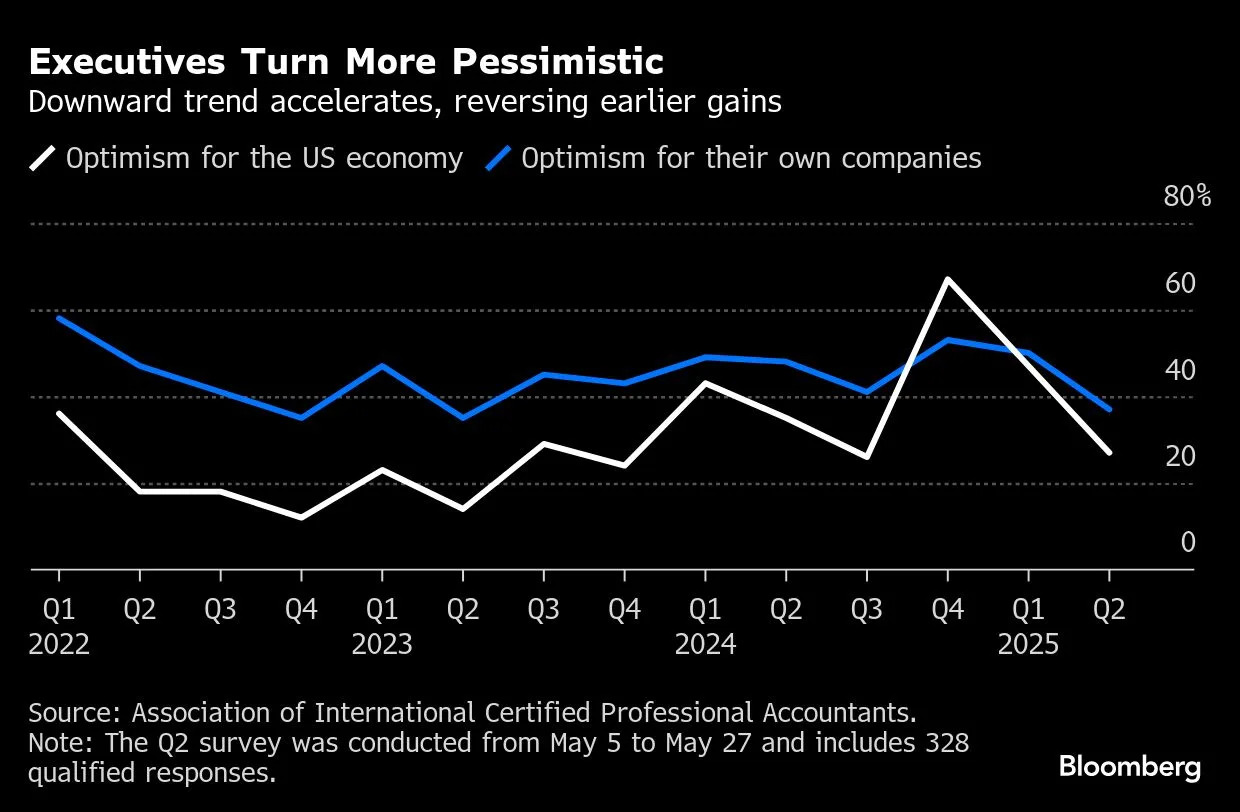
On Wednesday, MEMA, the Vehicle Suppliers Association, raised alarms over China's tightened export controls on rare earth minerals, which are vital for automotive components and processed predominantly by China (over 90% of global supply). This move threatens car production, prompting urgent calls for action from US auto giants like General Motors, Ford, and Toyota, some of whom have already paused production. These restrictions are viewed within the context of escalating US-China trade tensions, exacerbated by President Trump's tariff policies and a fragile détente from May's Geneva talks. Trump has expressed frustration over negotiations with China's President Xi Jinping, while looming deadlines for reciprocal tariffs add pressure. Meanwhile, global responses include Japan and the EU seeking solutions to secure supply chains and fast-track export licenses. The situation is further complicated by Trump's doubled tariffs on steel and aluminum, legal challenges to his trade policies, and broader economic uncertainty impacting business optimism. As trade talks with partners like India and the EU intensify, the rare earth curbs highlight the intricate web of geopolitical and economic challenges facing the global auto industry and beyond.
Key Points
Summary
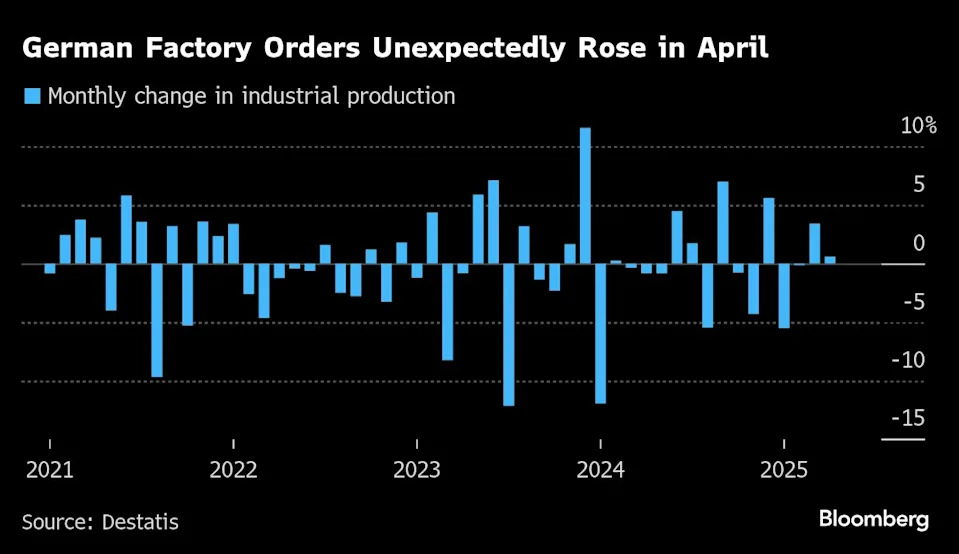
German factory orders unexpectedly increased by 0.6% in April, defying economists’ forecasts of a 1.5% drop following President Trump’s announcement of US reciprocal tariffs. This growth, reported by Destatis, was fueled by high demand for computer, electronic, and optical products, as well as orders for aircraft, ships, trains, and military vehicles. Despite trade tensions, the full economic impact of the tariffs on Europe remains delayed, with private-sector activity showing slight expansion. Germany’s export-dependent manufacturing sector is at risk, and the economy is projected to stagnate in 2023 after two years of contraction. However, a planned government spending boost could drive growth by 2026. The European Central Bank is also stepping in with its eighth interest-rate cut of the year, with another expected in September. Bundesbank President Joachim Nagel noted that frontloading of demand supported a strong first quarter, though momentum may weaken later. Commerzbank’s Chief Economist Joerg Kraemer highlighted an upward trend in orders, aided by ECB rate cuts, despite the dampening effect of tariffs. This resilience in German manufacturing underscores a complex economic landscape navigating global trade challenges and domestic policy support.
Key Points
Summary
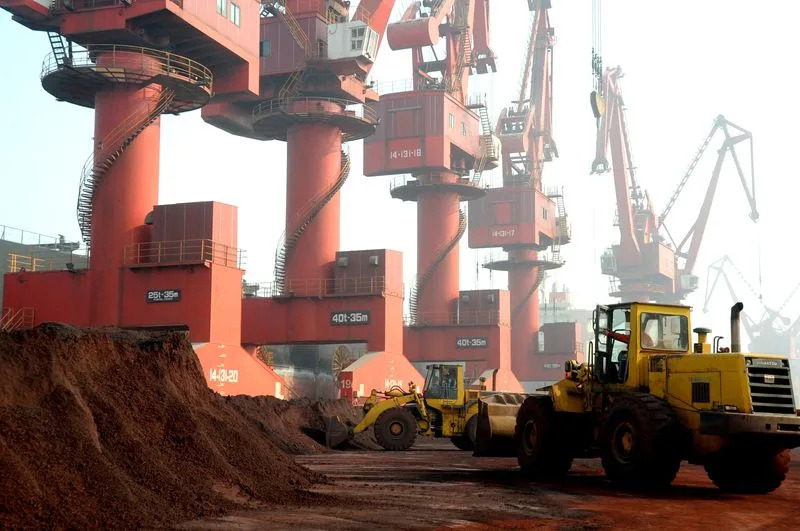
A group representing U.S. auto suppliers, MEMA, has raised alarms over China's export restrictions on rare earths, minerals, and magnets, urging immediate action to prevent disruptions in auto parts production. China, controlling over 90% of global rare earth processing, imposed licensing requirements for exporters in April, escalating tensions during a trade war with the U.S. sparked by tariffs under President Trump. These materials are vital for automotive components like transmissions, motors, and sensors. The restrictions have already impacted U.S. automakers, with Ford halting production of its Explorer SUV for a week in May due to shortages. MEMA, alongside the Alliance for Automotive Innovation, warned the Trump administration of severe supply chain risks and potential economic fallout. Rare-earth magnet exports from China dropped by half in April due to a complex permit process, intensifying concerns. The White House has yet to respond, while Trump recently accused China of breaching a temporary trade deal on social media. The situation remains unresolved, with high levels of concern across the vehicle supplier sector.

Key Points
Summary
Alphabet (GOOG, GOOGL) faces a potential stock drop of 15% to 25% if US District Judge Amit Mehta orders the divestiture of its Chrome browser, as warned by Barclays analysts. This follows Google's loss in a landmark antitrust trial in August 2024, where it was found guilty of monopolizing the search engine market. The Department of Justice has proposed severe remedies, including selling Chrome, sharing search data with rivals, and ending exclusivity deals that position Google as the default search engine on devices. Barclays analyst Ross Sandler highlighted that Chrome, with 4 billion users, contributes 35% of Google’s search revenue, making its potential sale a significant blow, possibly cutting Alphabet’s earnings per share by 30%. While the likelihood of divestiture remains low, it has risen after recent closing arguments. Judge Mehta’s remedy decision is anticipated in August, and Google plans to appeal. Separately, Alphabet agreed to a $500 million settlement with shareholders over antitrust compliance issues. Alphabet’s stock fell 1.5% on Monday and is down 10.6% year to date, reflecting investor concerns over these legal challenges.

Key Points
Summary
A growing divide within the Federal Reserve centers on how to address potential inflation from President Trump’s tariffs, with some officials like Governor Chris Waller advocating for overlooking temporary price increases and remaining open to rate cuts in 2025 if inflation nears the 2% target and the job market holds strong. Conversely, others, including Minneapolis Fed President Neel Kashkari and Dallas Fed President Lorie Logan, caution against cuts, citing risks of persistent inflation from tariffs and supply chain issues, and prefer maintaining current rates until clarity emerges on trade policies. Waller believes tariff effects will be fleeting, lacking the severe disruptions seen during the pandemic, while recent Fed minutes and Trump’s decision to raise steel and aluminum tariffs to 50% fuel concerns about longer-term price pressures. Logan stresses the importance of patience, noting that monetary policy is well-positioned to adapt as risks evolve, and warns against premature rate cuts that could spark inflation. Meanwhile, Chicago Fed President Austan Goolsbee acknowledges uncertainty but remains optimistic about a path to lower rates if current challenges subside. The debate continues as the Fed balances its dual mandate of stable prices and full employment amidst evolving trade dynamics.

Key Points
Summary
President Trump announced a significant increase in tariffs on steel imports, raising them from 25% to 50%, during a rally in Pennsylvania, claiming it will strengthen the U.S. steel industry. This move coincides with heightened tensions with China, as Trump accused them of violating a trade agreement without providing specifics. Meanwhile, his broader tariff agenda faces legal uncertainty; a federal appeals court temporarily upheld the tariffs after a trade court ruled their implementation unlawful, with potential Supreme Court involvement looming. The tariff hikes, including those on steel and aluminum, could raise costs for consumers, impacting prices from groceries to big-ticket items like cars due to the metals' widespread use. Amidst this, trade negotiations with the EU and India persist, with critical deadlines in June and July, including a potential 50% tariff on EU imports if no deal is reached. Legal challenges, such as the "major questions doctrine" previously used against Biden’s policies, now threaten Trump’s economic initiatives. Additionally, companies like e.l.f. Beauty, reliant on Chinese manufacturing, face increased costs but remain committed to their supply chains. The unfolding trade and legal saga continues to reverberate globally, with upcoming G7 discussions and court rulings set to shape the future of Trump’s tariff policies.

Key Points
Summary
Oil prices climbed as OPEC+ implemented a production increase of 411,000 barrels per day in July, a move that was less aggressive than some market fears, pushing Brent crude toward $65 and West Texas Intermediate above $62. This decision came amidst geopolitical unrest, with Ukraine targeting Russian air bases and Iran reacting to scrutiny over its uranium stockpiles, both of which could constrain supply from sanctioned OPEC+ nations. Trade tensions, exacerbated by President Trump's planned tariffs on steel and aluminum, continue to weigh on the market, contributing to a nearly 15% price decline this year following a turbulent period of tariff wars and a shift away from OPEC+'s previous high-price defense strategy. The production hike also signals Saudi Arabia's push to penalize over-producing members like Kazakhstan and Iraq, despite opposition from countries such as Russia and Algeria who favored a pause. Analysts at Westpac Banking Corp. predict Brent prices will hold within a $60-$65 range this summer, with potential slowdowns in output increases as OPEC+ prepares to review August levels on July 6.

Key Points
Summary
This article explores the fluctuating dynamics of Wall Street amidst policy shifts and trade tensions, spotlighting the "TACO" trade—an acronym for "Trump Always Chickens Out." This concept embodies the belief that President Trump frequently adopts a tough stance on tariffs but seldom acts on it, a pattern that has recently bolstered market confidence, especially after a US-China tariff deescalation. However, Trump's recent accusations against China on Truth Social and potential tech restrictions have introduced volatility, though markets, including the S&P 500 with its best May since 1990, largely adhere to the TACO narrative. Despite this, concerns linger as strategists like Julie Beale worry that Trump's reaction to the TACO label might prompt firmer tariff policies, heightening uncertainty. Meanwhile, retail traders exploit this uncertainty, buying dips in unprecedented numbers to leverage the predictable cycle of threats and deescalation, thus benefiting from market upswings.

Key Points
Summary
US Treasury Secretary Scott Bessent revealed that trade negotiations with China are currently stalled, emphasizing the necessity for direct talks between President Donald Trump and Chinese President Xi Jinping to resolve the complex issues. Despite recent discussions in Switzerland that saw both nations step back from imposing over 100% tariffs on each other’s goods, tensions are escalating again due to US actions such as revoking Chinese student visas and restricting sales of chip design software and jet engine parts to China. Additionally, the US has targeted Huawei by attempting to block its sales of advanced AI chips globally, drawing sharp criticism from Beijing. Meanwhile, domestic legal battles over Trump’s “reciprocal” tariffs continue, with a US court ruling them largely illegal, though an appellate court has temporarily upheld them during the appeal. Bessent remains hopeful, noting upcoming trade talks with Japan and asserting that international partners are still negotiating in good faith despite the legal uncertainties surrounding US trade policies.
.png)
Key Points
Summary
A federal appeals court has temporarily reinstated President Trump's extensive tariffs, reversing a prior ruling by the US Court of International Trade that declared their enactment unlawful. The US Court of Appeals for the Federal Circuit issued a temporary stay, allowing time for legal review, with the administration's briefings due by June 9. Despite the legal uncertainty, Trump's tariff agenda remains a cornerstone of his economic policy, with the White House prepared to escalate the matter to the Supreme Court if needed. The tariffs, including reciprocal duties and China-focused levies, continue to impact global trade, with ongoing negotiations involving India, the EU, and Taiwan. Corporate America, including tech giants like Nvidia and Apple, grapples with export controls and tariff threats, while analysts warn of potential economic repercussions, such as an accelerated US debt ceiling deadline. The situation remains fluid, with international tensions, particularly with China over tech and student visas, adding complexity to trade relations.

Key Points
Summary
Nvidia reported mixed Q1 results for the fiscal year 2026, ending April 27, with revenue of $44.1 billion, exceeding Wall Street expectations by nearly 2.7% and reflecting a 69% year-over-year growth. However, earnings per share of 81 cents fell short of the anticipated 85 cents, despite a net income of $18.8 billion, up 26% from last year. The shortfall was attributed to a $4.5 billion charge due to US export restrictions on its H20 AI chips to China, with an anticipated $8 billion revenue hit in Q2. CEO Jensen Huang emphasized the soaring global demand for AI infrastructure, likening it to essential utilities like electricity. Nvidia plans to mitigate losses by introducing a lower-cost AI chip for China, with production starting in June. Data center revenue, at $39.1 billion, drove most of the quarter’s gains. Despite the earnings miss, Nvidia’s stock rose nearly 5% after-hours, closing at $141.40. The company remains focused on leading in agentic AI amid intensifying competition, while other US firms and even Bitcoin mining companies pivot toward AI infrastructure development.

Key Points
Summary
China has accused the United States of using tariffs as a weapon to coerce other nations into reducing trade with Beijing, vowing to retaliate against any country that makes deals against its interests. The US has imposed tariffs on all trading partners under the guise of "equivalence" and is pushing for "reciprocal tariffs" negotiations. This has led to a significant drop in US stocks as companies grapple with the uncertainty of tariff policies. Despite the tensions, China has expressed a willingness to engage in trade talks with the US, although the White House has clarified that China now faces tariffs of up to 245% on imports to the US. The ongoing trade war has also impacted various sectors, with the airfreight industry potentially losing $22 billion in revenue due to tariffs and the possible closure of the de minimis exemption. Additionally, the situation has led to increased costs for US consumers, with examples like the price hike of rice crackers in Chinatown, New York City, reflecting the broader economic impact of these trade policies.

Key Points
Summary
US stocks experienced a significant downturn on Monday as President Trump intensified his criticism of Federal Reserve Chair Jerome Powell, sparking concerns about the central bank's independence. The S&P 500, Nasdaq, and Dow Jones Industrial Average all saw substantial declines, with the Dow dropping nearly 1,000 points. Trump's focus on lowering interest rates and his threats to remove Powell have added to market volatility, especially as investors navigate the shifting landscape of his tariff policies. The US dollar weakened to its lowest level since 2022, while gold and bitcoin reached new highs, reflecting investor uncertainty. Amidst this backdrop, the earnings season continues with key reports from Tesla and Alphabet this week, which could provide insights into how companies are coping with the current economic environment. The market's reaction to these earnings will be closely watched to gauge whether stocks have bottomed out or if further declines are expected.

Key Points
Summary
Donald Trump's 2024 campaign promise to tackle inflation played a significant role in his election, as voters were weary of the high prices during the Biden administration. However, once in office in 2025, Trump's policies have taken a sharp turn towards promoting inflation. He has introduced massive import tariffs, which have raised the effective tariff rate on imports from 2.5% to around 27%, directly increasing the cost of numerous consumer goods. This shift in policy has led to a significant change in economic forecasts, with inflation now expected to rise to 3.4% by the end of the year, up from previous estimates. The Federal Reserve, concerned about these inflationary pressures, has not cut interest rates as anticipated, and the likelihood of rate cuts has significantly decreased. Trump's actions are not only tolerating inflation but actively encouraging it, defying economic advice and historical lessons from past administrations. His approval ratings are beginning to reflect public discontent, with his economic handling receiving the lowest marks in recent polls, mirroring the public's growing concern over rising prices and economic stability.


