

Key Points
Summary
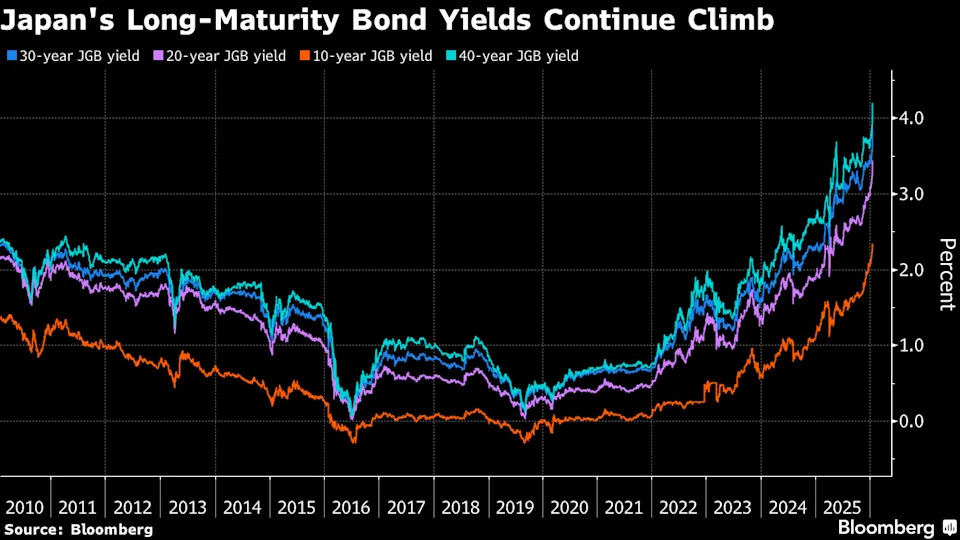
The Japanese bond market experienced a significant slump, with yields reaching record highs, as the 40-year rate surpassed 4% for the first time since its 2007 debut. This surge, driven by investor skepticism over Prime Minister Sanae Takaichi’s proposal to cut food taxes without a clear funding source, has led to fears of increased government bond issuance. Since Takaichi’s October appointment, 20- and 40-year yields have risen by about 80 basis points, reflecting broader concerns over government spending and inflation. The volatility in Tokyo has rippled into global markets, impacting US Treasuries and bonds in Australia and New Zealand. Despite the selloff, the higher yields are attracting foreign investors, who now account for 65% of monthly cash JGB transactions. Meanwhile, local insurers sold a record amount of long-term bonds in December, signaling bearish sentiment. As Takaichi calls for a snap election on February 8, the bond market remains a critical indicator of investor confidence, with potential global repercussions if a JGB meltdown intensifies.

Key Points
Summary
In 2025, China recorded a historic $1.2 trillion trade surplus despite U.S. tariff hikes under President Trump, which reduced U.S. orders by a third. This prompted a strategic shift to diversify exports to lower-income markets like South America, Africa, and Southeast Asia. However, Reuters interviews with 14 export salespeople reveal significant challenges behind the impressive figures. New markets often yield smaller, less profitable orders, reducing commissions and increasing financial uncertainty for workers. Sales staff also face heightened stress, longer hours, and health issues like insomnia, as they navigate unfamiliar markets and intense competition. Industrial profits dropped 13.1% year-on-year in November, reflecting economic strain. Experts warn that relying on foreign markets for growth is unsustainable, as weak domestic consumption forces Chinese firms to compete overseas, eroding profits. The pressure on sales agents, coupled with risks like longer payment cycles and client defaults, suggests that replicating 2025’s trade success may be difficult in the future.
Key Points
Summary
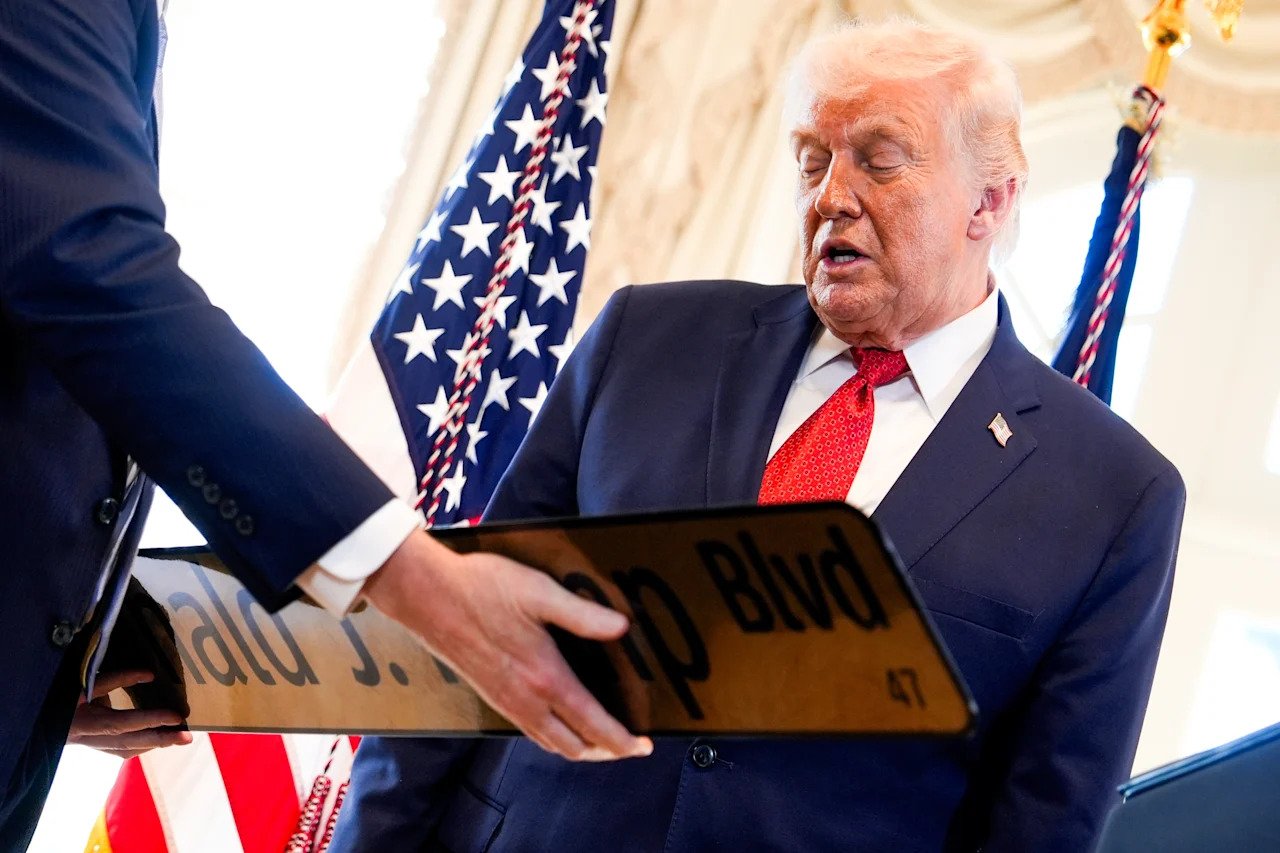
President Donald Trump has tied his pursuit of Greenland to his frustration over not winning the Nobel Peace Prize, as revealed in a letter to Norway’s Prime Minister. Initially citing national security, Trump now appears motivated by personal grievance. In response to European opposition to the Greenland purchase, he announced tariffs of 10% on eight countries—Denmark, Norway, Sweden, France, Germany, the UK, the Netherlands, and Finland—starting February 1, 2026, increasing to 25% by June if unresolved. These nations, already facing US tariffs, criticized the move as damaging to transatlantic ties, with leaders like Denmark’s Mette Frederiksen rejecting blackmail. Economically, Goldman Sachs estimates a minor GDP impact on Europe, while Deutsche Bank warns of potential European retaliation via selling $8 trillion in US assets, risking a weaker dollar. Trump also expressed concern over the US Supreme Court’s delay in ruling on his trade duties, calling it a national security issue. The escalating trade tensions have unsettled global markets, though some analysts believe Europe’s economic resilience may mitigate long-term effects.

Key Points
Summary
European stock markets experienced a sharp decline, with the Stoxx Europe 600 Index dropping 1.1%, as Donald Trump reignited a trade war by threatening tariffs on eight European countries over Greenland. Announced on Saturday, the tariffs start at 10% from February 1, rising to 25% in June unless a deal for Greenland’s purchase is secured. Sectors like automakers and luxury goods, heavily exposed to the US market, saw significant losses, while defense stocks rose amid geopolitical tensions. European credit risk indicators spiked, and the EU is contemplating retaliatory tariffs on €93 billion of US goods, pausing a key trade deal. US equity futures also fell, though markets were closed for a holiday. Analysts warn that while the direct economic impact of tariffs might be manageable, a deeper rift in Western alliances could have severe, hard-to-predict consequences. Some market participants remain optimistic, citing Trump’s history of backing down (“TACO” moments) or potential legal constraints, but short-term volatility and uncertainty dominate sentiment. Meanwhile, the euro’s fallout may be limited due to Europe’s capital importance to the US, and some see this as a catalyst for greater EU unity and strategic autonomy.

Key Points
Summary
The European Union is preparing to impose tariffs on up to $108 billion of US goods in response to President Trump's threat of 10% tariffs on eight European nations—Denmark, Norway, Sweden, France, Germany, the UK, the Netherlands, and Finland—starting February 1, escalating to 25% by June if no agreement is reached on the US purchase of Greenland. Trump's pursuit of Greenland, driven by national security concerns and its rich natural resources like rare earth minerals and potential oil reserves, has intensified transatlantic tensions. European leaders have criticized the move as blackmail, warning of a breakdown in decades of cooperation, and have paused a recent trade deal's approval. Protests in Denmark and Greenland reflect public opposition, while the US Supreme Court has yet to decide on the legality of Trump's trade actions. Trump's administration insists on Greenland's strategic importance against Russia and China, but the EU remains firm, exploring diplomatic solutions alongside countermeasures. This escalating trade conflict underscores deeper geopolitical and economic rifts between the US and Europe.

Key Points
Summary
US stock futures plummeted on Monday following President Trump's threat to impose a 10% tariff on imports from eight European countries opposing US control of Greenland, with S&P 500 futures dropping 1.1%, Dow futures 0.8%, and Nasdaq 100 futures 1.5%. European markets also stumbled, with Germany's DAX down 1.2% and France's CAC 40 shedding 1.4%, while the targeted nations criticized the move as damaging to transatlantic ties. Asian markets were mixed, with gains in South Korea and Taiwan contrasting losses in Hong Kong and Japan, despite China's reported 5% economic growth in 2025. US markets were closed for Martin Luther King Jr. Day, following minor declines in major indices last week. Analysts warn of potential long-term shifts in geopolitical and financial alignments due to Trump's policies, as upcoming US earnings reports and inflation data, including the PCE index, could further influence market sentiment. Meanwhile, oil prices dipped slightly, and precious metals like gold and silver saw gains amidst global uncertainties.

Key Points
Summary
President Trump announced on social media a 10% tariff on eight European countries, effective February 1, escalating to 25% by June 1 if no agreement is reached on the US purchase of Greenland. Targeting Denmark, Norway, Sweden, France, Germany, the UK, the Netherlands, and Finland, Trump claims Greenland is vital for national security against China and Russia, mocking Denmark's defenses. Protests in Denmark and Greenland oppose the plan, while former NATO head Anders Fogh Rasmussen criticized Trump’s tactics as a distraction from Ukraine. Meanwhile, the US Supreme Court is reviewing Trump’s tariff authority under a 1977 emergency law, a case watched by companies like Costco hoping for refunds. Trump warns a negative ruling would be disastrous for US trade power. Additionally, the US struck a trade deal with Taiwan to boost semiconductor production, while Canada and China agreed to lower tariffs on electric vehicles and farm goods. European ambassadors plan an emergency meeting to address Trump’s latest moves, amid ongoing tensions over Greenland’s autonomy under Denmark and military presence from NATO countries.

Key Points
Summary
European Union lawmakers are on the verge of blocking a trade deal with the United States due to President Donald Trump’s threats to impose tariffs on countries supporting Greenland amid US claims over the territory. Manfred Weber, head of the European People’s Party, declared the agreement untenable under current circumstances, despite partial implementation following negotiations by EU Commission President Ursula von der Leyen. The deal, which includes a 15% US tariff on EU goods in exchange for reduced EU duties on American products, faces opposition in the European Parliament, exacerbated by Trump’s new 10% tariff (potentially rising to 25%) on European goods starting February 1. This move has drawn sharp criticism from EU leaders like von der Leyen and French President Emmanuel Macron, who warn of damaged transatlantic relations. Additionally, EU lawmakers, including trade committee chair Bernd Lange, are pushing to suspend the deal and consider retaliatory measures using the EU’s anti-coercion instrument. The situation remains fluid as parliament members debate linking Greenland’s sovereignty to the trade agreement, with growing calls to freeze negotiations until US aggression subsides.

Key Points
Summary
This article explores the complexities of solar panel adoption in the U.S., focusing on the pitfalls of leasing versus owning. While solar promises reduced utility bills and increased home values (up to 6.9% per SolarReviews), many homeowners lease panels, entering contracts up to 25 years with escalating payments and early buyout fees. These leases become liabilities during home sales, as buyers often hesitate to assume the financial burden, sometimes forcing sellers to pay off contracts costing tens of thousands. Despite this, leasing has grown, with 36% of solar projects under such arrangements by mid-2024, up from 22% in 2021, fueled by lower upfront costs and recent tax credit changes favoring leasing companies. The expiration of a 30% purchase credit in 2025 may push more toward leases, though experts warn of long-term costs. Owned solar, conversely, is highlighted as a valuable investment amid rising energy costs, with real estate agents and homeowners like John Bulik in Denver advocating for ownership over leasing due to its financial and practical benefits. The article underscores the need for better consumer education on solar contracts to avoid misleading sales pitches and ensure informed decisions.

Key Points
Summary
This article explores Tesla's decision to shift its Full Self-Driving (FSD) feature to a subscription model starting February 14, as announced by CEO Elon Musk, moving away from one-time purchases. This reflects a wider corporate trend, especially in tech, to prioritize recurring revenue through subscriptions, which are easier to market for innovative services. Tesla’s strategy aligns with its vision of becoming an AI and robotics powerhouse, envisioning a future of autonomous robotaxis that could eliminate the need for car ownership. However, this model raises concerns about consumer control, as car software subscriptions limit owners’ ability to repair or understand their vehicles, clashing with the American ideal of car ownership as a symbol of freedom. Consumer resistance to recurring fees, like past objections to heated seat subscriptions, persists, yet companies continue to push such models for profit. The article also touches on broader subscription challenges, including difficulties in canceling services and legal issues, such as Amazon’s $2.5 billion FTC settlement over Prime enrollment practices. Ultimately, Tesla’s move underscores a tension between innovation-driven subscription models and traditional notions of ownership and autonomy in American culture.

Key Points
Summary
Nvidia faces a significant setback as Chinese customs officials have blocked shipments of its H200 AI chips, prompting suppliers to halt production of critical components like printed circuit boards. Despite recent US approval for sales in China and Nvidia's anticipation of over 1 million orders, the customs ban—communicated to logistics firms in Shenzhen—has disrupted plans for deliveries expected as early as March. This move, which caught Nvidia off guard as shipments arrived in Hong Kong, reflects broader regulatory uncertainty in China, where competing government agencies debate Nvidia's role amid a push for domestic chip self-sufficiency. Potential restrictions, such as licensing regimes and mandated domestic-to-imported chip ratios, add to the complexity. As a result, many Chinese customers are canceling H200 orders, opting instead for advanced, US-banned Nvidia chips like the B200 and B300, driving a black market. This is not the first restriction Nvidia has encountered in China, as last summer's ban on the lower-performance H20 chip showed similar challenges. The situation underscores the intricate balance of international trade policies, domestic ambitions, and market dynamics affecting Nvidia's operations in China.

Key Points
Summary
America’s trading partners are pivoting away from the U.S. market due to President Donald Trump’s aggressive and unpredictable trade policies, characterized by high tariffs and protectionist measures. Canada, a frequent target of Trump’s tariffs, recently slashed its 100% import tax on Chinese electric vehicles in exchange for reduced tariffs on Canadian farm products like canola, signaling a significant realignment towards China. This move, led by Prime Minister Mark Carney, risks U.S. retaliation, especially with the upcoming renewal of the U.S.-Mexico-Canada Agreement (USMCA), crucial for Canadian exports. Meanwhile, the EU is forging trade pacts with Mercosur and India, and China is diversifying exports to Europe and Southeast Asia, achieving a record trade surplus despite U.S. tariffs. Trump’s strategy, aimed at protecting American industries and raising revenue, often appears arbitrary, targeting countries for political reasons and straining global trade relations. Canada’s deal with China, while beneficial for farmers and EV sector competitiveness, faces domestic criticism for threatening autoworkers and complicating ties with the U.S., highlighting the broader tension in international trade dynamics under Trump’s policies.

Key Points
Summary
This article discusses the impending US Supreme Court ruling on President Trump's extensive tariffs, which were imposed under a 1977 national emergency law, testing the limits of presidential authority. The decision, awaited after arguments in November, could impact businesses like Costco, which are seeking refunds on import duties through lawsuits. Trump has voiced strong concerns about losing tariff powers, labeling it a severe setback for the US. Additionally, Trump proposed tariffs on nations opposing a US takeover of Greenland for national security reasons, though specifics remain unclear. On the international front, a US-Taiwan trade deal aims to cut tariffs and enhance tech investments, despite objections from China, while Canada and China agreed to reduce tariffs on electric vehicles and farm products, signaling a thaw in trade tensions. These developments highlight the complex interplay of trade policy, national security, and international relations under Trump's administration, with significant economic and geopolitical implications pending the court's decision.

Key Points
Summary
York Space Systems Inc., a Denver-based space and defense company backed by AE Industrial Partners, is set to raise up to $544 million in an initial public offering by selling 16 million shares priced between $30 and $34 each. At the high end, this would value the company at about $4.25 billion. Founded in 2012, York Space builds and operates spacecraft and satellites for clients like the Pentagon and US Air Force, having completed 74 missions. The IPO, expected to price on Jan. 28, comes amid growing activity in the space and defense sector, with mixed results from recent listings like Karman Holdings and Firefly Aerospace. Financially, York Space reported a reduced loss of $54.9 million on $280.9 million in revenue for the nine months ended Sept. 30. Post-IPO, AE Industrial Partners’ stake will drop to 24%, though it will maintain voting control. The offering, led by Goldman Sachs, Jefferies, and Wells Fargo, will see shares listed on the NYSE under the ticker YSS, marking a significant step for the company in a competitive industry landscape.

Key Points
Summary
Efforts to renew enhanced Obamacare subsidies, which expired recently, are encountering significant obstacles despite their political importance, having previously led to a government shutdown. Bipartisan talks on Capitol Hill have stalled, with lawmakers expressing doubt about a near-term resolution as they head into a recess. The White House's latest healthcare framework ignores the subsidy issue, prioritizing prescription drug prices and health savings accounts, while President Trump continues to criticize Obamacare. Meanwhile, the end of the open enrollment period for most exchange plans has locked in higher rates for many, with government data showing an 800,000 drop in Healthcare.gov sign-ups. These subsidies, benefiting 22 million Americans with an average annual saving of $705 in 2024 per KFF, are critical, yet the focus in Washington remains elsewhere. Congressional negotiations are paused, with potential resumption late January, but Democratic leaders aim to separate healthcare from looming shutdown debates. As premiums rise, the issue may become a key talking point for the 2026 campaign rather than an immediate fix, leaving millions grappling with increased costs.

Key Points
Summary
Nvidia, a leading AI chipmaker, is grappling with geopolitical challenges in China, where US-China tensions have led to a 45% revenue decline to $3 billion in the latest quarter. Despite a recent approval to sell its H200 chip in China with a 25% tax, import restrictions persist. Globally, Nvidia remains dominant, reaching a $5 trillion valuation last fall and reporting a 60% revenue surge to $57 billion in Q3. However, long-term risks loom as China's push for domestic chips and potential development of open-source AI software could challenge Nvidia's edge, particularly its CUDA platform, which locks developers into its ecosystem. Analysts warn that if Chinese open-source tools gain global traction, Nvidia's hardware and software leadership could weaken. CEO Jensen Huang emphasizes the need for the US to stay ahead in AI innovation, highlighting China's rapid progress. While national security concerns drive trade restrictions, Nvidia argues that losing access to China may harm US competitiveness as Chinese developers innovate with limited resources.


