

Key Points
Summary
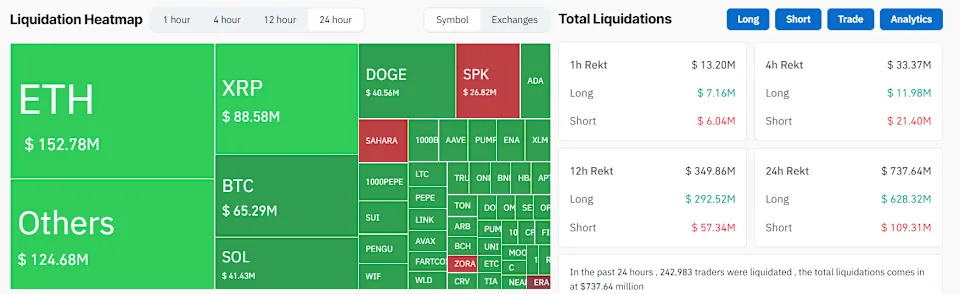
A sharp crypto market pullback on Tuesday resulted in nearly $735 million in liquidations, predominantly affecting bullish traders with $625.5 million in long position losses. Ether (ETH) and XRP bore the heaviest brunt, recording liquidations of $152.78 million and $88.58 million respectively, outpacing Bitcoin’s $65.29 million despite its larger market cap. Other tokens like Solana (SOL) and Dogecoin (DOGE) also saw significant losses at $41 million and $40 million. The selloff, lacking a clear trigger, was likely worsened by profit-taking near key resistance levels—ETH close to $4,000 and Bitcoin above $118,000—coupled with high leverage among altcoin traders. As of now, ETH trades near $3,540 (down 3.6%), XRP at $3.25 (down 6%), and Bitcoin at $116,800 (down under 2%). Liquidations, which occur when leveraged positions are forcibly closed due to price drops beyond margin thresholds, can signal market sentiment and potential reversals. When analyzed with open interest and funding rates, such data offers insights into overcrowded trades and strategic entry or exit points in volatile, overleveraged markets.

Key Points
Summary
This article explores China's evolving stance on stablecoins, initially viewed with skepticism by the People’s Bank of China in 2021 as threats to the global monetary system. However, with stablecoins like Tether’s USDT and Circle’s USDC becoming integral to financial systems, especially in Asia, Beijing is feeling pressure to act. The U.S. GENIUS Act, which offers regulatory clarity for fiat-backed stablecoins, is seen as reinforcing dollar dominance, prompting China to consider regulated offshore yuan (CNH) stablecoins to internationalize its currency while maintaining control. Animoca Group’s Evan Auyang highlights Hong Kong’s role as a testing ground for such initiatives, including potential HKD stablecoins. He predicts a global trend where countries will adopt regulated stablecoins following the U.S. lead, not to overthrow the dollar but to create viable alternatives for trade and settlement. This marks a significant shift from viewing stablecoins as speculative to recognizing their future role in finance.

Key Points
Summary
This article explores the potential of the iShares US Technology ETF (NYSEMKT: IYW) as a life-changing investment for patient, disciplined investors. Highlighting the importance of consistent contributions over many years, it showcases the ETF’s impressive historical performance, with average annual returns of over 19% across 5, 10, and 15 years, significantly outpacing the S&P 500. Focused on technology stocks, the fund includes major holdings like Nvidia, Microsoft, and Apple, which make up nearly half its value, appealing to those optimistic about the tech sector’s future. The article provides projections showing how regular investments, even at conservative growth rates of 8-12%, can grow into substantial sums over decades. While acknowledging market volatility and the higher risk of growth stocks during downturns, it suggests that with time, recovery and new highs are likely. The ETF’s reasonable expense ratio of 0.39% and broad exposure to over 140 tech stocks make it an attractive option for long-term portfolios, though investors are cautioned to consider their risk tolerance and market conditions before investing.

Key Points
Summary
The cryptocurrency market, led by Bitcoin (BTC), continues to rally despite mixed economic signals and concerns over President Trump’s proposed tariffs. Bitcoin recently achieved an all-time high of $123,153.22 and remains strong around $119,000, with analysts predicting it could exceed $150,000 this year. Amidst this, the Federal Reserve is likely to keep interest rates unchanged, supported by robust June retail sales, though market hopes for rate cuts persist. The article recommends investing in crypto-focused stocks like Visa Inc. (V), Robinhood Markets, Inc. (HOOD), and Interactive Brokers Group (IBKR), citing their strong growth potential for 2025 and positive earnings revisions in recent months. Visa is enhancing global transactions via the Solana blockchain, while Robinhood and Interactive Brokers offer direct cryptocurrency trading platforms. Despite tariff-related uncertainties, recent trade deals with Japan, the Philippines, and Indonesia signal potential economic stability, further supporting the bullish outlook for Bitcoin and related investments.

Key Points
Summary
South Korea's Financial Supervisory Service (FSS) has reportedly issued informal warnings to local asset managers, urging them to limit exposure to cryptocurrency exchange-traded funds (ETFs) and U.S.-listed digital asset firms such as Coinbase (COIN) and Michael Saylor's Strategy (MSTR). According to the Korean Herald, this directive aligns with the FSS's 2017 policy, which bans regulated financial institutions from holding or purchasing equity in digital assets. This development seems to mark a shift from earlier indications that South Korea might relax crypto trading rules, instead reinforcing a cautious stance. An FSS official noted that despite changing regulatory environments in both the U.S. and South Korea, firms must adhere to existing guidelines. The FSS was unavailable for immediate comment on the matter. This move highlights South Korea's ongoing regulatory scrutiny of cryptocurrency investments, reflecting a broader tension between innovation in digital assets and the need for financial stability and compliance within traditional financial systems.
** there, let's get to the heart of this PayPal news with some key points and a quick summary, all formatted just as you requested. Don't panic, I've got this covered!
Key Points
Summary
PayPal has unveiled PayPal World, a groundbreaking platform aimed at revolutionizing cross-border commerce by uniting major global payment systems and digital wallets. Announced on Wednesday, the initiative partners with entities like India’s NPCI (UPI), China’s Tenpay Global (Weixin/WeChat), and Latin America’s Mercado Pago, alongside PayPal and Venmo, targeting over two billion users worldwide. The platform simplifies international transactions, allowing users to pay via local wallets, such as using PayPal on Weixin in China or UPI for U.S. purchases. PayPal’s CEO, Alex Chriss, highlighted its potential as a game-changer in addressing the complexities of global money movement. Set to launch this fall, PayPal World will enable seamless payments for non-PayPal users as well, with plans to expand Venmo’s merchant payment capabilities by 2026. This ecosystem promises to bridge massive transaction volumes, exemplified by Mercado Pago’s $58.3 billion in Q1 2025 and India’s UPI hitting $238 billion in June alone, marking a significant step toward frictionless global payments.
Key Points
Summary
Coinbase Global (COIN), the largest US cryptocurrency exchange, and PNC Financial Services Group (PNC), a major Pittsburgh-based bank, have formed a strategic partnership to integrate cryptocurrency services into PNC’s offerings. This collaboration enables PNC’s retail and institutional clients to buy, sell, and hold digital assets directly through their accounts, while PNC provides banking services like settlement to Coinbase. Announced as an early-stage relationship, the partnership will soon launch PNC’s first crypto offering using Coinbase’s crypto-as-a-service infrastructure. This move reflects a growing trend of traditional banking and crypto converging, fueled by a more favorable regulatory environment under the Trump administration, unlike the restrictive Biden-era policies. The crypto market’s surge, with a capitalization nearing $4 trillion and Bitcoin hitting record highs above $122,000, has spurred interest from major banks like Morgan Stanley and JPMorgan Chase to explore digital asset opportunities. PNC, known for its conservative “brilliantly boring” brand, sees this as a way to meet client demand for secure crypto access without embracing volatility. This partnership exemplifies how even traditional institutions are adapting to the rising mainstream adoption of digital assets amidst evolving regulations and market dynamics.

Key Points
Summary
xTAO, a Bittensor-focused infrastructure company, made its public debut on Canada’s TSX Venture Exchange after securing $22.8 million from prominent investors like Animoca and DCG. The funds will support the expansion of its validator operations and the development of real-world products on Bittensor’s decentralized AI network. This listing follows TAO Synergies’ recent $10 million acquisition of TAO tokens, underscoring rising institutional interest in decentralized AI infrastructure. xTAO’s CEO, Karia Samaroo, emphasized the company’s mission to advance decentralized AI, positioning Bittensor as the “Bitcoin of AI” and leveraging TAO as a treasury reserve asset. Meanwhile, TAO’s market performance remains strong, trading above $440 with a 5.5% increase in the last 24 hours, outpacing the flat CoinDesk 20 index. Analysts are optimistic about the AI token sector, as retail traders increasingly seek exposure to innovative AI firms, especially with limited access to established players. xTAO aims to capitalize on this trend by providing essential tooling and validation layers to scale the Bittensor network.
Key Points
Summary
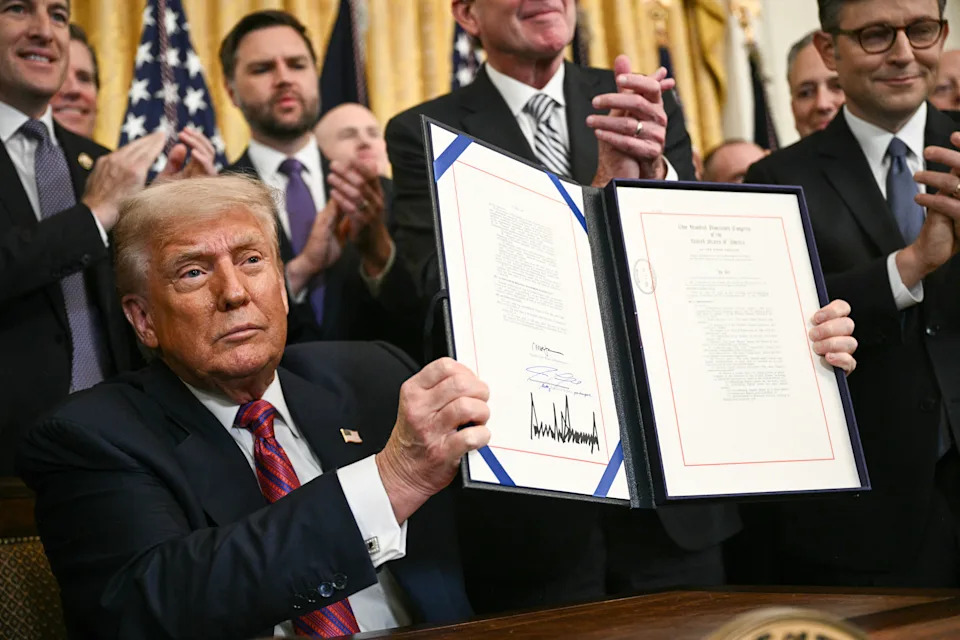
A growing trend among corporate treasuries involves investing in ethereum (ETH-USD), the second-largest cryptocurrency, alongside bitcoin (BTC-USD), to tap into decentralized finance infrastructure. Smaller crypto firms like BitMine Immersion Technologies, with over $1 billion in ethereum holdings, and larger entities like Coinbase Global, with $440 million in crypto assets, are leading this shift. Ethereum's price has surged 60% in the past month to nearly $3,800, though it lags behind bitcoin's year-to-date return of 26% with a 14% gain. Its blockchain, dominating with over 51% market share, supports smart contracts and tokenization, hailed as its "killer app" for enabling direct transactions without intermediaries. Companies like SharpLink Gaming and Bit Digital are also adopting ethereum-focused treasury strategies, with Bit Digital fully shifting from bitcoin. The recent GENIUS Act, signed by President Trump, regulates stablecoins on ethereum's network, fueling optimism and driving gains for firms like Circle, up over 600% since its IPO. However, not all companies prioritize ethereum; MicroStrategy remains staunchly bitcoin-focused. Experts clarify that ethereum's adoption complements, rather than replaces, bitcoin, reflecting diverse blockchain applications in corporate strategies. Despite potential rewards, ethereum's volatility, evident in price drops following market disruptions like Trump's tariff announcements, poses risks for corporate investors.
Key Points
Summary
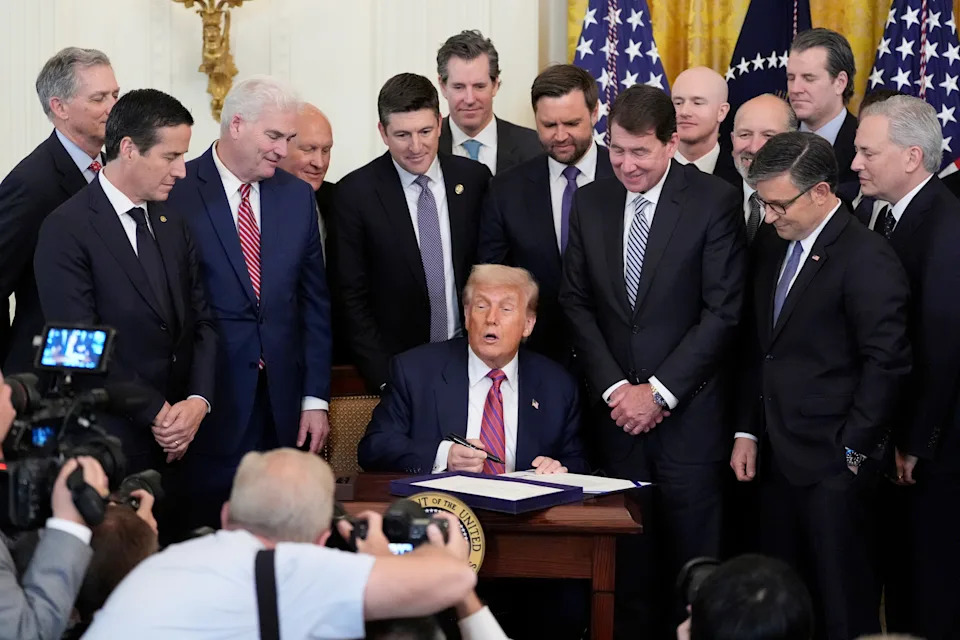
Trump Media & Technology Group Corp. (DJT) saw its stock rise 6% after revealing a $2 billion investment in bitcoin and related securities, fulfilling a May plan to become a bitcoin treasury company. This move positions bitcoin as two-thirds of its $3 billion asset portfolio, with an additional $300 million allocated for bitcoin-related options. Led by CEO Devin Nunes, the company aims to secure financial independence and shield itself from institutional discrimination while planning a utility token for its Truth Social platform. Concurrently, President Trump signed legislation creating a federal framework for dollar-backed stablecoins, boosting crypto adoption, and supported a new stablecoin (USD1) through World Liberty Financial. Inspired by MicroStrategy’s bitcoin acquisition strategy, Trump Media joins other firms stockpiling cryptocurrencies, though its stock has dropped 25% since May and 45% year-to-date, drawing skepticism from short sellers about the sustainability of such strategies. This development reflects Trump’s deepening ties to the crypto industry amid evolving regulatory landscapes.

Key Points
Summary
Robinhood Markets (NASDAQ: HOOD) has experienced a remarkable 350% stock surge over the past year, fueled by rising stock and crypto prices that boosted trading volumes on its platform. Despite this rally, the article argues that Robinhood remains a compelling buy before its July 30 earnings report. The company has rapidly expanded, doubling its funded customers and tripling assets under custody from 2020 to 2024, while achieving a 32.5% revenue CAGR. Its ecosystem now includes crypto, options, and tokenized assets, alongside AI tools and banking services. Margins have improved significantly, with gross margins reaching 94.4% in 2024, supported by economies of scale and high-margin offerings. Regulatory concerns over its payment for order flow model have eased with the SEC’s withdrawal of proposed restrictions. Additionally, subscription revenue from its Gold tier is growing, diversifying income streams. While its valuation appears high at 50 times adjusted EBITDA, analysts predict an 18% revenue CAGR through 2027, suggesting strong growth potential. The article highlights Robinhood’s appeal to retail investors through free trades and gamified investing, positioning it as a disruptor to traditional brokerages, though it notes caution with The Motley Fool not including it among top stock picks.

Summary unavailable due to network error.
Key Points
Summary
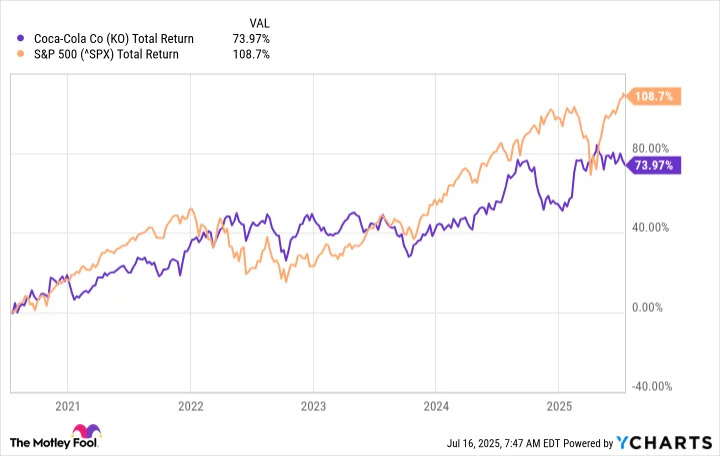
Coca-Cola (NYSE: KO) has enjoyed a strong year, emerging as a favored stock amid economic pressures and tariff changes due to its stability and global presence. Despite historically lagging behind the S&P 500 over the past five years, the company has shown resilience, with organic revenue up 6% in Q1 2025, even as net revenue dipped 2%. As a Dividend King with 63 years of consecutive dividend increases, Coca-Cola remains a safe haven for investors, bolstered by its status as the world’s largest beverage company with nearly $47 billion in sales. Management projects 4-6% organic revenue growth long-term, driven by acquisitions like Costa coffee and market expansion, especially in developing regions where it holds just 7% market share. While economic challenges and pricing pressures loom, the company’s local production and strong fundamentals position it for potential growth over the next five years. However, it may not consistently beat the market as investors shift from safe stocks, though its dividend and safety make it a valuable portfolio addition.

Key Points
Summary
This article explores three midstream energy stocks as smart investment options for a $2,000 budget, highlighting their stable cash flows, high yields, and growth potential. Energy Transfer (ET) stands out with a 7.5% yield, improved financials, and $5 billion in growth projects targeting AI data centers and LNG exports, trading at a low valuation. Enterprise Products Partners (EPD) is presented as a dependable choice with a 6.9% yield, 26 years of distribution growth, and a focus on natural gas liquids, offering steady income for long-term investors. Genesis Energy (GEL), while riskier, shows promise as a turnaround story after selling its soda ash business to reduce debt, focusing on offshore pipelines and marine transportation with potential for significant cash flow and distribution increases. The midstream sector is noted for trading below historical valuations despite stronger financial positions, making it an attractive area for investment. The article emphasizes the recurring, fee-based revenue models of these companies, which provide insulation from commodity price volatility, positioning them as compelling choices for income and growth-focused investors in the current market.

Key Points
Summary
Bitcoin's price trajectory in 2025 has paralleled stock market patterns, dipping to a low in early April before climbing to a new high within six weeks. Influenced by economic uncertainties like President Trump’s tariff plans, bitcoin's role as a safe haven during volatility is debated, yet financial author Robert Kiyosaki remains a staunch advocate. In posts on X, Kiyosaki has called bitcoin "the biggest opportunity in history," suggesting it offers an easy path to wealth and warning against the fear of making mistakes that keeps many from investing. He predicts bitcoin could hit $250,000 by the end of 2025, though it currently stands at about $108,000, reflecting a 15.5% year-to-date gain—outpacing the S&P 500, Dow, and Nasdaq. Over five years, bitcoin’s value has skyrocketed by over 1,000%, fueling Kiyosaki’s optimism. He believes even a fraction of a bitcoin could become "priceless" in two years, potentially making investors very rich, and questions why more people aren’t seizing this chance.

Key Points
Summary
Vanguard, the world’s second-largest asset manager, has surprisingly become the largest institutional shareholder in MicroStrategy (MSTR), holding 20.5 million shares worth $9.26 billion, despite its historical skepticism toward Bitcoin as a speculative asset. MicroStrategy, the leading corporate Bitcoin holder with 601,550 BTC valued at $74 billion, has seen its stock soar over 3,700% in five years under Michael Saylor’s Bitcoin treasury strategy. This approach, while lucrative, involves significant risks due to the use of debt and leverage, making it vulnerable to Bitcoin price drops and market shifts. Vanguard’s investment suggests an indirect embrace of Bitcoin exposure, contrasting with its public stance and decision to avoid spot Bitcoin ETFs, unlike competitors like BlackRock. Meanwhile, MSTR stock remains popular among analysts, with most recommending a "Strong Buy," though concerns about overvaluation and the high cost of acquiring Bitcoin near $120,000 raise questions about sustainability. This dynamic highlights the evolving relationship between traditional finance and digital assets.


